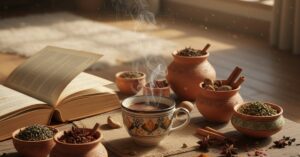
Crafting Meaning: Yogic Chai’s Role in Life and Philosophy
A narrow street unfolding in early morning light. A lone vendor adjusting his cart, the quiet steam of boiling water making patterns against the sky. India’s daily ritual beginning anew. These moments are woven deeply into the cultural fabric, as is the cup of chai that greets the new day.
Advaita Vedanta and the Quiet Act of Tea
The teachings of Advaita Vedanta offer a profound lens through which we can view our existence—“the Self is Brahman.” Beyond philosophical text, this idea adheres itself to our moments of solitude. Think of chai not as a metaphor but as an iteration of this concept. An evidence of living slowly and deeply. When one sips chai, the conscious act represents a small sacred space in a world cluttered by loudness.
Nisargadatta Maharaj’s oft-discussed notion of ‘I Am’ invites us to observe how we connect with existence. The cup of chai, simple yet profound, aligns with this. It’s an element that provokes self-inquiry beyond regular introspection. Not unlike Ramana Maharshi’s method of self-inquiry, with chai, you embark on a journey inward, savoring each draw as a tangible piece of the philosophical puzzle.
The Philosophy of the Sovereign Self
Advaita teaches us about the irreducible essence of selfhood. What role does inner authority, influenced by the body and mind, play when you warm your hands around a cup of chai? A sovereign ritual, inviting contemplation, does not bend to external dictates but listens first to its conscience.
No philosophies of Locke or Overton will dictate how one views a day begun with a cup of this fragrant elixir. The act itself mirrors our need for quiet rebellion, an insistence that the internal witness remains primary. This is more than philosophy; it’s experiential insight, a homage to living as a full human being—answerable foremost to our own nature.
Chai’s Traditional Wellness Descent and the Ingredients
Let us turn to the aromatic world of spices that constitute chai’s soul. Each, grounded in Ayurvedic knowledge, serves more than just sensory delight. Consider cardamom—’Elachi’ as it’s known in the local vernacular—analyzed for both its metabolic and digestive roles. To call it a ‘superfood’ would, however, do disservice to its deeper context.
Ginger and black pepper, warming by virtue of their pungency, may assist in circulation according to traditional medicine. Yet the key lies not in pharmaceutical equivalence but in understanding their historical and cultural canvas. These ingredients come together not to heal miraculously but to be part of a bigger picture—as numerous studies suggest, they contribute to lives lived fully, not necessarily longer.
The Rituals of Nature: Finding Stillness
Pause for a warm cup. Not as an interruption but as an anchoring. Why does silence take root more readily when chai is in hand? Because the ritual becomes a keystone of truth. The sensation of porcelain meeting skin, the warmth creeping through fingers—all part of a dialogue with nature.
Observe your surroundings: rain pattering on leaves, city streets awash in early morning stillness. Chai facilitates this attentiveness by being an emblem of simplicity, bridging the individual to the universe naturally, without the banality of insistence on ‘being present’.
Cultural Story: Chai Through India’s Lens
One must acknowledge how chai is interwoven with Indian life. A nexus of social psychology and hospitality. The chai wallah—an institution in its own right—operates not only as a business but as a cultural liaison. Train platforms transform from pragmatic spaces to social theaters, thanks to a cup of chai shared amid a symphony of chaotic togetherness.
Monsoon rain and the naturally earthen scent paired with a heavy ceramic of steaming chai tell stories as old as time, resonating in the kulhad tradition. These cultural engagements speak volumes about the unique place chai occupies, beyond pages of travelogues or exotic narratives.
From Kitchen to Craft: Culinary Infusion
The intersection of culinary creation and chai offers a realm where art interlaces with tradition. Baking with masala chai is not about trends but about calculating the dance between individual spices—a narrative of harmony. Consider darker notes in chai reduction; their purpose in a butter cake is as much about the texture of experience as it is about flavor.
Use of Yogic Chai blend is not a creative “game changer” but a convergence of practiced skill and culinary past. There is a reason to each ingredient’s participation in the recipe—the unwritten dialogue between cardamom and vanilla. Notice the subtle alteration, the sensation of earth and warmth working through the senses.
Concluding Thoughts on Yogic Chai
Explore the unhurried journey in which a tranquil tea cup becomes philosophically indispensable. This isn’t a call to action, but an invitation. An invitation to incorporate Yogic Chai as a subtle foundation in your narrative of daily life. Such stories stay with us, surprising in their simplicity, profound in their presence. A full human life respects such practices, stories born as they are, from an unbroken chain of hands, hearts, and thoughtful minds.