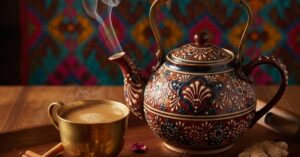
Yogic Chai: Exploring Philosophy, Craft, and Culture
The Contemplative Sip: Yogic Chai and the Art of Stillness
Early morning, the world is swathed in a gentle haze, the city still in slumber. The quiet is profound. In this silence, a cup of Yogic Chai offers more than just warmth. It invites reflection, a moment suspended between the demands of the day and the tranquility of the now. Like the philosophies of Advaita Vedanta that whisper of a deeper unity, each sip calls for a quiet inquiry into one’s true essence. “The Self is Brahman,” a phrase often spoken but little understood, mirrors this stillness. It invites a journey inward, much as a focused meditation that begins with the ritual of a well-brewed chai.
The Upanishads, with their poetic depths, compel us to explore beyond the fabric of the material. In parallel, the act of preparing chai—watching the tea leaves unfurl, the spices releasing their fragrant secrets—grounds us in the tangible here and now. In both, we find an intersection where philosophy meets the corporeal, in a cup that reflects both inquiry and serenity.
The Sovereign Self: A Stand for Individual Conscience
In the realm of personal authority, Yogic Chai stands as an emblem of inner sovereignty. To consider what it means to live responsibly to one’s conscience is to unravel the threads that bind us to external validations. As Overton and Locke have espoused, there lies within us an irrefutable rights discourse, one that finds its expression not in political rhetoric but in the philosophical musings of human dignity.
When with a mug of chai, we look upon our reflections, it’s a reminder of the individual journey—the choices led by conscience rather than convention. The chai ceremony becomes an allegory for self-governance, where deliberation and a willingness to question take precedence over passive consumption.
Traditional Wellness: Understanding Chai’s Ingredients
The composition of Yogic Chai is a testament to Ayurveda’s profound legacy. Each ingredient—ginger, cardamom, cinnamon, cloves, black pepper, and Assam tea—carries with it an ancient dialogue that resonates with modernity. Cardamom, known traditionally for its warming essence, imparts not only flavor but a history of medicinal use. Ginger, with its zesty vigor, has been celebrated for its comforting influence on the digestive fire—Agni.
These spices, studied for their potential roles in supporting well-being, are more than just flavorants; they are narratives of human interaction with nature. The interweaving of culinary art and traditional wellness within each cup helps demystify the layers of cultural and historical complexity inherent in each sip.
Nature and Ritual: The Phenomenology of an Anchored Moment
The act of making chai can be likened to a natural ritual, reminiscent of quiet moments in landscapes untouched by time—like the stillness found before dawn breaks over a mountain ridge. As the aroma builds, releasing its soft plumes into the air, stillness becomes palpable. The hands, cradling the warm ceramic of a chai cup, find ease in this heat.
The phenomenology of drinking chai is akin to the rhythm of nature—a universe condensed into a moment of presence and continuity. It is not the cliched ‘be present’ but a grounded sensation of existence, singular and collective.
Indian Chai Culture: A Daily Grammar
India’s relationship with chai is profound, its roots as deep as the Banyan trees that line its railways. The chai-wallah, a purveyor of this ubiquitous brew, becomes a fixture in the social landscape—a merging point for disparate lives. The tang of monsoon on the air, matched by the smoky warmth of a clay kulhad filled with chai, anchors memories and socio-cultural exchanges alike.
This is no romanticized tableau of exoticism, but an authentic portrait of everyday life where chai serves as the axis around which stories are shared, transitions marked, and breaths taken. Understanding chai in India is to understand its cyclical nature within society, a comfort and companion through both prosperity and adversity.
Culinary Craft: The Artistry of Chai
Beyond the traditional chai lies an expansive culinary world where its spices perform as artisans. Consider a butter cake kissed with the warmth of masala spices, where cardamom dances with vanilla—a synthesis of taste and texture that offers an evolution of what chai can mean. It is here that the YogicChai blend transforms, more than mere ingredient, into a cornerstone of culinary creativity.
The process of crafting such flavors is not about rapid-fire kitchen antics but conscious composition—a ballet of aromas that demands thoughtful introspection. Each chai-infused creation tells a story, urging the serious home cook to embrace a practice of intentional artistry.
Embracing the Fullness of Yogic Chai
To savor Yogic Chai is to embark on a journey that meanders through philosophy, craft, culture, and the deliberate pause. It unfolds in intricate layers, welcoming the culturally curious and philosophically inclined with open arms. In every cup, a clarion call to authenticity, continuity, and a life richly pondered. Until the last sip cools and the tea stains the bottom of an empty cup, a call to action is unnecessary—a compelling truth in itself.