Yogic Chai: Crafting Stillness and Conscious Savoring
As the sun sets beyond the horizon, casting a gentle amber glow through your kitchen window, the day seems to momentarily pause. It is in this stillness that Yogic Chai finds its voice—whispering stories of traditions old yet ever-renewing. To hold a freshly brewed cup of chai invites both an inward journey and an outward expression—a harmonious confluence of Indian cultural philosophy and the art of living well.
The Philosophy of Slowness and Presence
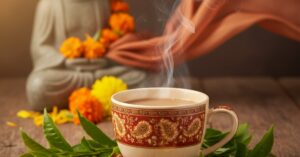
There’s a profound teaching in Advaita Vedanta—a non-dual philosophy originating from the Upanishads. It suggests that our truest Self is Brahman, the ultimate reality, infinite and unmoving. In practice, this becomes a call to slowness, to simply be as the Self, amidst life’s rush. Each strand of steam rising from a chai cup becomes a cosmic pointer toward the infinite, a reminder to savor not just the flavor but the moment.
Ramana Maharshi, an exemplar of self-inquiry, asks us to direct the mind within and ponder the nature of ‘I’. Holding a cup of Yogic Chai, one might find that such introspection becomes more accessible, seated as you are in the quiet embrace of both tea and thought. Here, chai is not metaphor, but complement to contemplation—a scaffold for reflection without distraction.
The Sovereign Self and Chai’s Intimate Ritual
In considering the sovereignty of the individual conscience, we echo the musings of thinkers like Overton and Locke. What does it mean to act from inner authority? Drinking chai, especially in a culture steeped in ritual, becomes an act of sovereignty, a daily enactment of personal ritual over dictated routine.
Yogic Chai respects this private dance by offering no prescriptions, no aphorisms hastily scribbled on teabag tags. Instead, it serves as a subtle anchor, allowing each person to honor their inner witness with an authenticity that resists external definition.
Understanding Wellness Through Chai’s Ingredients
The spices that steep within a cup of Yogic Chai tell tales of tradition and wellness dating back centuries. Ginger, revered for its warmth, traditionally works in Ayurveda to invigorate and balance; Assam tea leaves, bold and malty, offer the mind a gentle stimulant—a springboard for clarity and focus.
Cardamom, with its cooling sweetness, counterbalances life’s excesses and aids digestion, both physically and metaphorically. In acknowledging their roles—we appreciate, rather than exploit, the potential of these ingredients. Here, education precedes any claim of remedy or cure, reminding us of the deeper narrative of wellness beyond modern marketing.
The Chai Ritual as a Gateway to Nature
Consider the simple act of taking a sip as the seasons change. Standing by an open window on a crisp autumn morning, chai becomes an interface with the natural world. A stream of warmth against the chill outside, each sip anchors you more concretely in the experience of this changing world.
The first sip of chai on a frigid day is not ‘magical’ but real—an expression of a felt experience, a visceral turn toward wholeness through ritual. This small act of drinking chai becomes a profound gesture of living alongside, rather than apart from, nature.
Chai Culture: The Social Fabric of Indian Life
Chai in India is more than a beverage; it is an integral part of life’s rhythm. From the bustle of crowded train stations, where chai wallahs with kettles in hand offer respite, to humble village corners, chai effectively creates spaces where social barriers melt and moments of authentic connection arise.
The Indian ritual of chai ties together people and place, community and time. Regional variations—spicy masala in one region, fragrant tulsi blends in another—reflect the rich tapestry of Indian life. This cultural complexity is not romanticized but deeply respected, honoring chai’s place as a true social equalizer.
Culinary Craft: Cooking with Chai’s Intrinsic Harmony
In the kitchen, Yogic Chai unveils new possibilities as a creative ingredient. Imagine a chai-infused custard, where the velvety sweetness of vanilla intertwines with cardamom, the flavors harmonizing in a perfect culinary symphony.
Fashioning a chai reduction for poaching pears or incorporating it into a butter cake reveals how chai’s spices animate dishes, offering depth without dominance. This is where culinary craft becomes artistry—a thoughtful application rather than a chaotic attempt to reinvent.
Ultimately, to make chai part of your life is not about following a trend. It’s about accepting a gentle invitation to slow down and engage with the world more conscientiously. Crafting stillness becomes not just an abstract aspiration but an everyday practice, realized in the intimacy of a well-made cup.