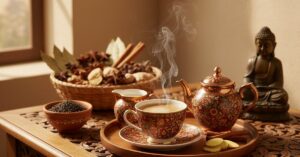
Understanding Yogic Chai: A Philosophical and Cultural Exploration
The Delicate Intersection of Philosophy and Chai
In a quiet corner of a morning, where the world’s demands are yet to invade, the simplicity of chai exerts its profound influence. Perhaps it is its modest guise—a humble combination of tea leaves, milk, sugar, and spices—that belies its deeper significance. Here, the essence of Yogic Chai invites an exploration that transcends the boundaries of mere beverage consumption. It is an experience rooted in both the ancient wisdom of Advaita Vedanta and the rhythmic cadence of Indian daily life.
An Inquiry into the Self: Advaita Vedanta’s Gentle Murmur
At the heart of Advaita Vedanta lies the declaration “Tat Tvam Asi”—’Thou Art That’, a reminder of the non-duality between self and the universal consciousness. This principle, while often abstract to the uninitiated, finds its echo in the stillness afforded by a cup of chai. With each sip, there is an invitation to silence the restless chatter of the mind, to engage in self-inquiry, peeling away layers of ego much like the spices that unfurl their flavors. The act is not merely one of drinking but of meditative presence, of discovering that ‘I Am’—as Nisargadatta Maharaj expounds—is the unadorned truth that requires no external validation.
Ramana Maharshi and the Quiet Act of Self-Inquiry
For Ramana Maharshi, the path of self-inquiry is not about adding to the self but understanding what you are not. As one contemplates over chai, this distinction becomes palpably clear—the warmth in the hands juxtaposed against the cool awakening of understanding. The chai cup becomes a catalyst for reflecting on the difference between the transient and the everlasting, the seen and the seer, echoing Maharshi’s pursuits.
Individual Sovereignty: A Sip of Intrinsic Freedom
Yogic Chai, through its rich tapestry of influences, also speaks to the idea of individual sovereignty. What does it mean to sip tea knowing you are answerable first to your conscience, not to societal diktats? Historical undercurrents of personal autonomy flowing from Locke and Overton resonate here. As you cradle your mug, there is the profound realization that true authority must spring from within—from a place that finds dignity in silence and reflection, much like the perfectly balanced blend of a well-steeped chai.
The Historical Cadence of Chai in Indian Life
India’s chai culture is not just a sensory indulgence but a narrative of connection, community, and culture. Train platforms bustling with chai wallahs, clinking glasses amidst the anticipation of departure; rain-drenched monsoon afternoons where tea stalls entice with steaming kettles; and quiet kulhad moments that seem to transport time itself. Yogic Chai is thus both participation in a shared tradition and a solitary journey into cultural depths.
A Tradition Beyond Words
The practice of chai extends into the philosophical. In a nation where diverse beliefs coexist, chai is a quiet equalizer, a common language beyond words. It is a pause that reframes a gathering, offering companionship in solitude and silence in shared noisiness—a phenomenon echoed within India’s own cultural and spiritual pluralism.
The Art of Craft: Chai as a Culinary Muse
The crafting of chai is an exploration in itself. Culinary possibility lies in this interplay of spices—ginger’s warmth with the soft sweetness of cardamom, the sharp kick of black pepper against the smoothness of Assam tea leaves. Yogic Chai’s blends invite not just appreciation but participation in gastronomic creativity. Steeped reductions become backbones of flavorful adventures, inviting one to acknowledge that the simplest gestures can lead to deeper revelations of taste.
The Ritual of Culinary Chai
Infusing the chai act into culinary practices is more than making recipes—it is about crafting moments. When chai spices infiltrate a dessert, they carry stories of monsoon evenings and family gatherings, of warm kitchens and whispered philosophies. Chai, here, is an art form, constantly evolving yet eternally grounded in tradition.
The Quiet Call of Nature in Ritual
Finally, the act of chai consumption becomes a nature ritual in itself. Imagine the first sip on a winter morning, where condensation silently forms on glass and warmth threads through fingers like whispers. Yogic Chai becomes an anchor, a reason to pause, offering a retreat into the natural pace of being. Observing steam rise and dissolve into the air is itself a lesson in impermanence—the understanding that both moment and chai are to be savored, then released.
In all these ways, Yogic Chai exists not merely as a beverage but as an encounter with life’s intricacies. It is an exercise in thoughtfulness, an exploration of philosophy, a celebration of culture, all within the gentle confines of a ceramic cup. Embrace its quiet richness, and let it become part of the considered life you seek.