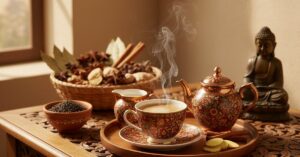
Yogic Chai: A Thoughtful Exploration of Flavor and Philosophy
It begins with a scent: earthy, spicy, hinting at centuries-old craft. As you lift the cup to your lips, the warmth rises, awakening the senses not just to taste, but to contemplation.
Steeping in Tradition
Yogic Chai is more than a blend of spices and tea leaves; it is a living tradition that invites us to pause and reflect. A product of India’s rich cultural tapestry, it occupies a unique space at the intersection of culinary craft and spiritual inquiry.
To speak of chai is to speak of India—of stories told over steaming cups on monsoon days, of bustling railway stations where time slows as every sip marks the rhythm of life. Unlike the hurried swigs of modernity, true chai invites slowness and specificity—a thoughtful engagement with both taste and time.
Advaita Vedanta and the Ritual of Tea
The teachings of Advaita Vedanta offer a unique lens through which to view the act of making and savoring chai. At the core of this philosophical tradition is the principle that the Self and the universe are one—Brahman is the Self. In the simplicity of chai-making, there is an echo of this unity.
Consider the act of boiling water, the spices melding, the careful infusion of tea leaves. Each step is a deliberate act of creation, a reflection of the Self engaging with the material through mindful action. As Ramana Maharshi’s self-inquiry seeks to strip away the layers of ego until only the pure Self remains, so too does the act of making chai strip away distractions, revealing a moment of pure being.
The Sovereign Self: Chai as a Reflection
In the solitude of one’s thoughts, a cup of chai serves as more than a sensory experience; it becomes a mirror to the sovereign self. Philosophers like John Locke contemplated the irreducibility of the human conscience, asserting that no external force holds sway over our inner truths.
While sipping chai, the noise of the outside world recedes. Here, in this quiet moment, one finds a space to reflect on the self, to honor individual conscience. Yogic Chai thus acts as a tool for introspection, a gentle catalyst encouraging us to ponder the question: What does it mean to be truly free within ourselves?
Crafted Tastes, Authentic Ingredients
Each ingredient in Yogic Chai carries with it a history. Ginger, cardamom, cinnamon, cloves—each has been traditionally used not only for their flavor but also for their reputed health benefits in Ayurveda. Modern research continues to explore these properties, cautiously noting that these spices may support various aspects of wellness.
However, the allure of chai lies not in its purported health benefits but in the harmony of its flavors: the sharp bite of ginger, the sweet warmth of cinnamon, and the aromatic dance of cardamom—all melding into an experience that engages the senses and the spirit.
The Ritual and the Nature
In the act of brewing chai, one finds a reconnection to nature and form. Picture a quiet morning: the fog hanging low, a single beam of light cutting through. Here, with a cup in hand, there is a meditation on stillness and nature’s unhurried rhythm.
The chai cup serves as an anchor—warmth radiating through the fingers—inviting a deep inhalation as the senses awaken to the subtle symphony of scents. Trees bend to the breeze, leaves rustle softly, and as one lifts the cup, the world momentarily pauses.
Indian Chai Culture: A Daily Sonata
In India, chai is life’s punctuation mark, punctuating conversations and sealing social bonds. It’s woven into the fabric of daily life, ousting sleep’s last cobwebs in the pre-dawn light and accompanying late-night philosophizing.
The chai wallah, the seller of tea at street corners and train platforms, is an institution unto themselves, a purveyor of both sustenance and society. With each cup poured, stories are exchanged, barriers dissolve, and connections are forged, illustrating the drink’s role in bridging the personal with the communal.
The Chai Cup in the Culinary World
Beyond the cup, chai serves as an intricate flavor base in the culinary arts. Infusing its robust spices into baking reveals layers not just in taste but in approach—each spice carries nuance, and understanding its interaction with other ingredients is both science and art.
Imagine a simple butter cake elevated by the spice of masala—a reduction of steeped chai transforming texture and taste. In cooking with chai, one respects its origins while also inviting playful exploration. It’s an exercise in being present, mirroring the effortlessness that Yogic Chai teaches us.
Yogic Chai is not a quick-fix spirituality or a commodity to be consumed thoughtlessly. It is an intersection: a practice of patience, a taste of tradition, and a philosophical journey in each sip. As you explore its flavors, may you find a renewed sense of stillness and sovereignty, guided by the gentle warmth of tea and the wisdom it quietly imparts.