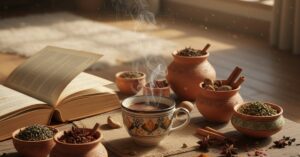
The Essence of Cardamom in Crafting Authentic Chai
There are moments woven into the fabric of life that demand pause, reflection, and a quiet surrendering to the ordinary—those moments when time itself seems to stretch and breathe. One such ritual is the making of chai, particularly a blend that leans gently into the aromatic embrace of cardamom. To explore this tea is to embark on a journey through the senses, down roots that are intertwined with cultural and philosophical significance.
Cardamom: The Heartbeat of Chai
Cardamom, a spice as ancient as the texts that describe it, carries a warmth and depth that are reminiscent of the very essence of India itself. Known as the ‘Queen of Spices’, cardamom has long been revered not only for its complex aromatic profile but also for its emboldening qualities in a cup of chai. It is the top note, the whisper, and the lingering warmth all at once.
The Allure of Cardamom-Forward Chai
In crafting a cardamom-forward chai, one does not merely add a spice to tea; rather, one communes with a tradition, a story that is steeped in the confluence of peoples and places. It is more potent than its counterparts; its aroma is both soothing and invigorating, much like the first soft rays of sunlight warming chilled skin on a winter morning. In Yogic Chai, cardamom stands not as a solitary star but as a guide, leading the palate through a landscape of vibrant spices.
Connecting Philosophies: Advaita Vedanta and the Art of Chai
There exists a dialogue between the quiet act of brewing chai and the contemplative tradition of Advaita Vedanta. The brew process, slow and attentive, mirrors the inward turn of the mind advocated by sages like Ramana Maharshi. To hold a cup of chai is not a mere gesture; it’s an invitation to lose oneself and find the ‘Self’—a gentle inquiry much aligned with ‘I Am’ or the realization that ‘the Self is Brahman.’
The very act of preparing chai allows for a tangible encounter with stillness, a realignment with the inner narrative that transcends the transient chaos of modern life. Here, notions of time dissolve, and all that remains is the hand, the cup, and the introspective quiet of a brewing thought.
The Sovereign Self Through the Lens of a Chai Cup
The crafting of chai is a reclamation, much like the philosophical exploration of the sovereign self. To answer first to one’s conscience means to honor the instincts that derive neither from society nor tradition but from an innate understanding of one’s place in the world. This is not to disparage external influences but to remind that the center of gravity resides within.
Similarly, the process of making chai is not just about tradition; it’s a reflection of the personal relationship one has with the act itself. Each variation, whether a sprinkle of additional cardamom or a pinch of saffron, is an assertion of individuality—the self asserting its domain.
Traditional Wellness and the Cardamom Spice
Cardamom occupies a revered place within traditional wellness practices. Indigenous to the rainforests of southern India, this spice has been traditionally used for its role in enhancing digestion and its calming effects on the mind. Modern research supports these uses, noting cardamom’s efficacy in digestive support and its potential role in mood elevation.
However, it is critical to approach the wellness angle with sobriety and respect—steering clear of exaggerated claims. Engaged curiosity and personal inquiry into its cultural context offer far more lasting wisdom than chasing fleeting health trends.
The Ritual of Chai: A Journey through Nature and Time
Envision a crisp autumn morning; the city still shrouded in a cocoon of sleep. There is a palpable quiet, a kind of spiritual gentleness in the act of making a cup of chai. The air hums with anticipation as the spices crackle and bloom, infusing the kitchen with the promise of warmth. As the mist from a cup of Yogic Chai unfurls into the room, the heart, once guarded, begins to open.
There is something incredibly profound about sipping chai in solitude against a backdrop of towering, silent trees or the muted blue of pre-dawn. It is an experience rooted in acute sensation—the steam fogging a pair of glasses, the unexpected floral note of cardamom rising in the mid-current of the chai’s body.
The Cultural Tapestry of Chai in India
Chai, in Indian culture, goes beyond the beverage itself; it is the connective tissue of day-to-day social life. Picture the unassuming chai wallah whose morning ritual brings him into communion with commuters, artists, and itinerant philosophers, each with a story as complex as the chai in their clay cups.
The existence of chai on a train platform, amid the synchronized chaos of arrivals and departures, embodies a transitional grounding. It is where strangers find in chai a shared language, where lives temporarily intersect and diverge, all underpinned by the earthy essence of cardamom. Such is the humility and authenticity of chai culture that seeks neither to impress nor to beguile but to simply be.
Culinary Craft: The Poetry of Cardamom in Baking
To bake with chai, particularly one that celebrates cardamom, is to explore a palette of flavors that remain respectfully bold yet unobtrusive. While undisputed as a protagonist within chai, cardamom finds a versatile counterpart in vanilla, harmonizing within the matrix of a baked good, such as a butter cake.
Elevating the craft further, a chai reduction can serve as an aromatic base, imbuing the confection with layers of flavor. This is culinary invention, not in the sense of novelty for novelty’s sake but as an extrapolation of tradition—a metric of the unhurried labor of love.
The Quiet Redemption in a Cup
Ultimately, the cultivation of a cardamom-forward chai is emblematic of a return to quietude, intent, and the art of listening—to spices, to water, to quiet moments. It is a return to choices grounded in authenticity and appreciation for the process as much as the result.
Let us, with Yogic Chai in hand, find cause to pause and reflect, and not as an imposition or mandate, but as an exercise in nourishing the Self—a moment worth savoring every day.