Exploring Yogic Chai: Stillness, Craft, and Culture
In the season of monsoon, amid the parched earth welcoming the first rain, there is a scene often overlooked yet profoundly meaningful. On a bustling train platform in India, a chai wallah performs the age-old ritual of chai-making. As steam rises and fragrance envelops the air, a curious calm takes hold. Here begins our exploration of Yogic Chai—not merely as a beverage but as an embodiment of stillness, craft, and culture.
A Philosophical Prelude
To understand Yogic Chai, one must first delve into the philosophical underpinnings that animate its essence. The teachings of Advaita Vedanta, with its central tenet “the Self is Brahman,” invite us into a dialogue on the nature of self and consciousness. This is no casual inquiry. It demands a rigorous introspection, akin to the methodical ritual of preparing chai, where each step is a meditation in itself. What, then, does it mean when Nisargadatta Maharaj states, “I Am”? It is an assertion of being, untethered from the flux of external validation. Ramana Maharshi’s practice of self-inquiry further directs us inward, hardening focus on the self beyond superficial boundaries.
Chai as Contemplative Ritual
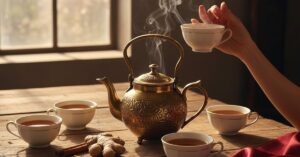
In this dance of thought and action, Yogic Chai becomes a conduit of stillness. Consider the act of holding a warm cup on a winter morning. The steam rises slowly, urging the senses to pause. The heart settles into a rhythm not governed by haste. Each sip is a step inward, a brush with simplicity, where the tangible texture of silence finds form.
The Craft of Chai: More Than Mere Beverage
For Yogic Chai, the journey is as essential as the destination. The drink is composed not only of Assam tea and a medley of spices—ginger, cardamom, cinnamon, cloves, and black pepper—but also of a storied tradition of craftsmanship. Each item plays a role both in Ayurveda and in the delightful harmony of taste. Cardamom, revered historically, is known in Ayurvedic traditions for its potential to balance doshas. Modern studies have echoed its beneficial relationship with digestion, offering a testament to an enduring wisdom.
Chai Spices: A Culinary Symphony
The veracity of chai’s acclaim lies in its intricate symphony of ingredients. Ginger offers warmth, often linked to comfort and digestive ease. Black pepper, with its sharpness, complements the smoothness of Assam, while cinnamon’s sweetness adds depth, creating a flavor profile that is both complex and comforting. Such craftsmanship involves more than mere combining; it transforms humble ingredients into an experience greater than the sum of its parts.
Chai Culture in India: More Than a Drink
Chai in India is less a beverage choice than a cultural tapestry infused with community and time. Every monsoon, with rain tapping lightly on awnings, cups of chai tether strangers into shared silence and warm solidarity. The platform chai wallah becomes a chaireur of narrative and tradition, weaving connections among commuters and travelers alike.
Social Fabric and Chai
The charm of chai rests not only in its brew but also in its capacity to structure moments. In kulhads—clay cups that imbue a distinctive earthy aroma—chai transforms and transcends the ordinary, marking life’s transitions with reverence and wonder. These humble vessels hold stories untold and memories shared.
The Ritual Beyond the Mug
Stillness experienced with Yogic Chai extends beyond the rim of the cup. It invites a conscious return to ourselves, urging presence in the moment of the brew. This chai lives within tradition and personal inquiry, asking us to be witnesses to our own lives.
In the quietude of rain or the solitude of snowy dawns, let the art of chai-engagement remind us: slowness is not absence, specificity is not confinement. With each sip, we embark not upon a journey of escape but rather a return—one that finds us seated in introspection with a cup as our guide.
So, as you ponder the role Yogic Chai plays in your daily rhythm, consider it an invitation and a promise—a bridge between outer complexity and inner calm.