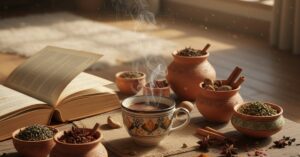
Whole Spice Chai: A Deliberate Journey Through Authentic Flavor
In a world that often praises expedience over experience, the humble act of sitting with a cup of whole spice chai offers a window into a more measured existence. The same can be said of its individual spices—each one a story, a history, an essence that is felt more than tasted. This is not your run-of-the-mill beverage discussion but an exploration into the soul of a culinary ritual that is both ancient and perennial, yet constantly evolving.
The Essence of Craft: A Dance of Ingredients
In the tapestry of chai, ginger and cardamom do not merely flavor the brew. They whisper of Ayurvedic intellect and deep-seated cultural memory. The pungency of ginger speaks to warming properties, while cardamom lends a sweet, almost etheric balance. Yet, to understand these spices is to appreciate their role beyond function—to see them as partners in a harmonious dance.
Ginger, known in Ayurveda for its capacity to kindle the ‘digestive fire,’ has been a cornerstone of traditional medicine. Its antispasmodic and anti-inflammatory properties are as celebrated in scientific circles today as they are in the storytelling of old apothecaries. Meanwhile, cardamom’s aromatic, flowing notes are more than scent—they are an embrace that wraps around the ethos of family gatherings and temple offerings.
Cinnamon and Cloves: The Complexity of Simplicity
Cinnamon and cloves—the former a gentle arbiter of warmth, the latter a punctuated note of spice—both serve as metaphors for the layers of chai that accumulate in complexity over the years. In Assam tea, the foundation of a great chai, these spices find their firmament. In every brew of YogicChai, these layers cascade over one another, like a spiritual inquiry conducted not with words but with flavors.
Modern research acknowledges cinnamon’s antimicrobial benefits, a finding that oversimplifies the centuries of lore that describe its tranquil, rounding influence on the body and soul. Similarly, cloves, with their surprisingly potent antioxidant profile, are more than a spice; they are a testament to embodied meditation, the kind where attention follows the inhalation warm with spice and the exhalation cooled by the immediacy of the moment.
The Philosophy on a Cup: Stillness in Motion
While many might think a cup of chai as a simple brew, those initiated into its layered richness know that it invites a quiet conversation with the self. Here, the teachings of Advaita Vedanta find their resonance in a way that scripted aphorisms cannot. As Ramana Maharshi has taught, self-inquiry is not passive. Nor, truly, is sipping chai. Both require attention and intention.
In this pause, we perceive our essence, the way Nisargadatta Maharaj spoke of with his succinct “I Am”. In a sublime second, made fuller by the warmth of whole spices, we are prone to notice nuances—the slight sweetness of black pepper or the grounding whispers of cinnamon—that might otherwise escape our journey through more hurried activities.
Chai as a Cultural Narrative
This ancestral brew stakes its place in India’s intricate social fabric. Imagine a train platform bustling with life, the sing-song call of a chai wallah, hot chai passed along in earthen kulhads—each element feeds into a cultural symphony that is, at heart, a dance of continuity and change. Chai is both contract and conversation, a language spoken in every corner yet as varied as the myriad spices that compose it.
For many, the distinct crack of a peppercorn or the muted hint of a clove becomes the bookmark for memories otherwise forgotten. Chai marks transitions indeed—a sip before departure, during the monsoon’s cleansing deluge, or alongside midnight musings—a symbol of timeless constancy.
The Craft Beyond the Cup
Utilizing the YogicChai blend in culinary endeavors further solidifies its role beyond a simple drink. Consider incorporating it into a butter cake, where the cardamom and vanilla entwine as if naturally destined, adding depth and balance. In bread, the spices act not in dominance, but in gracious underpinning, each slice resounding like a poem well crafted.
Even in abstraction, consider the reduction of chai to its essence, a syrup that might anoint panna cotta, the adventurous drizzle grounding each gentle bite in the familiar yet the unexplored. Through these culinary ventures, one finds not just the interplay of flavors, but a philosophic inquiry that asks—what does it mean for elements so varied to create something unified?
Conclusion: The Art of Simplicity
To hold a cup of whole spice chai is to cradle possibility, to embrace a moment imbued with history and grounded in immediacy. It urges one to live as a full human being, answerable first to conscience, and often only to taste. Embrace it, not as an indulgence but as a celebration of the simple, deliberate acts that make up a considered life.