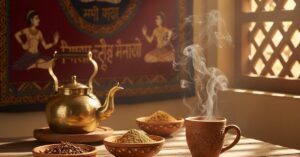
Yogic Chai: Delving into Tradition and Philosophy
In the heart of a bustling Indian train station, amidst the hum of life in transit, there exists a moment suspended in time: the chai wallah’s rhythmic clatter as he serves steaming cups of chai to travelers. It is here, in these unhurried exchanges, that we find the essence of what Yogic Chai seeks to capture — a harmonious blend of the ancient, the cultural, and the contemplative.
The Philosophical Substrate: Advaita Vedanta
Advaita Vedanta, the non-dualistic school of thought, challenges us to reconsider the nature of the self and the universe. Its central dictum, ‘the Self is Brahman,’ serves as an invitation to explore consciousness without division. This is not a mere intellectual exercise but a lived experience, much like savoring a cup of chai — an act of presence as flavors intertwine, inviting stillness and reflection.
In the teachings of Ramana Maharshi, we find parallels in the practice of self-inquiry and the quietude of the chai ritual. Both require attention to the nuanced flavor of the moment, an invitation to observe without judgment. Just as the chai leaves unveil their essence in hot water, self-inquiry peels layers of non-self to reveal the fundamental nature of being.
The Sovereign Self and Chai
Philosophically intertwined with Advaita, the idea of individual sovereignty stands as a testament to our innate autonomy. In the realm of chai, this finds expression in the unique touch each chai wallah or home brewer imparts upon their blend, echoing the self’s irreducible nature in the tapestry of human experience.
John Locke’s musings on natural rights resonate with the simple dignity of one choosing their cup of Yogic Chai—asserting integrity in every sip, recognizing that authority over one’s experience rests fundamentally within.
Traditional Wellness in a Cup
Yogic Chai invites you into a rich world where each spice speaks its own story. The warming bite of ginger, the aromatic caress of cardamom, the comforting depth of cinnamon—these are not mere ingredients, but elements with a history entrenched in Ayurvedic tradition.
Ginger has been traditionally prized for its invigorating warmth, cardamom cherished for facilitating digestion, and cinnamon revered for its balance. While modern science continues to explore these traditions, the act of combining these elements into a chai blend stands as an homage to a journey that transcends time.
The Senses Awakened Through Nature and Ritual
There is a primal satisfaction in the act of preparing chai—a ritual that anchors us, much like the slow flow of a mountain stream or the measured rustle of leaves in a forest. The temperate embrace of a chai cup in the morning chill affords us a rare chance to feel each sensation in its earnest form.
Cultural rituals have long appreciated the grounding power of such moments. In India, the stark monsoon may roll through cities and villages, but rain-soaked mornings with chai become instances of communion and narrative, where nature’s unpredictability is met with gratitude rather than haste.
The Cultural Pulse: Chai in Indian Life
Chai lies at the heart of Indian society — a subtle presence threading through conversations, negotiations, and borrowed time. The platform chai wallah becomes an everyday philosopher, servicing the transient communities who gather briefly, consuming shared warmth before the day’s next demand.
Regional chai variations reflect the diversity of India itself. In Assam, teas grow robust against humid vistas, yielding a malty fullness, while in Mumbai, roadside stalls offer a more portable, creamy rendition aimed at satiating commuters wrapped in hurried garments.
The Culinary Craft of Tea and Spice
The crafting of chai is an art of balancing forces. In the kitchen, cardamom mingles with vanilla, proposing an elegance to the curious cook; clove punctuates butter cakes with its sophisticated pungency; a reduction of masala spices infuses a simple syrup with depth. Here, chai transcends the cup to become a canvas for culinary exploration.
Yogic Chai embraces this approach with intention, respecting the provenance and interplay of each ingredient to honor not only tradition but innovation—truly a blend of craft and contemplation.
As you steep each cup, remember: Yogic Chai is more than a drink—it’s a narrative, a philosophy imbued in ritual, an inevitable rhythm in life’s contemplative choreography. Let your next cup be a reminder of that connection, a call to pause and savor every note it whispers.