Yogic Chai: Exploring Craft, Culture, and Philosophy
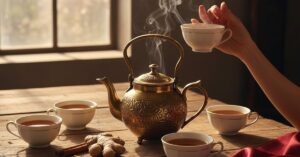
Early on a fog-draped morning in the Himalayan foothills, there is a peculiar silence. A suspension of sound between the first breath of dawn and the stirrings of a village waking. It’s here, in this sliver of stillness, that one finds the essence of Yogic Chai. The steam rising from a cup mirrors the mists curling through ancient cedars. But how did this modest brew come to embody such depth, such soul?
Philosophy & Stillness in the Chai Cup
The teachings of Advaita Vedanta whisper through the steam of Yogic Chai. Consider Ramana Maharshi’s gentle insistence on self-inquiry — a practice that invites one to dwell within, to ask persistently, “Who am I?”
One might think this is an intellectual exercise, until it is paired with the experience of chai. Here, the act of inquiry unfolds not in an abstract space, but in the sensations of warmth and flavor. Holding a cup invites a moment of reflection, a pause to silently question and listen. Nisargadatta Maharaj often spoke of the simplicity of “I Am,” not as a grand declaration but as a quiet, introspective knowing. Yogic Chai becomes a medium for this inquiry, each sip a minor meditation.
The Sovereign Self and Individual Conscience
In the quiet corners of our minds, we often grapple with authority. Who decides the moral compass we navigate by? John Locke postulated that the individual’s mind is sovereign, an idea resonating with the irrefutable self in Advaita.
Chai, in Indian culture, is communal yet deeply personal. It serves as a pause, a reflection point where one can reconnect with individual conscience. In the act of savoring a cup of chai, untouched by external diktats, one can merely be. Here lies the dignity of Yogic Chai — it bends to no dogma, respects no hurry.
Cultural Tapestry: Chai’s Rich History
In the rhythmic chaos of an Indian train station, the chai wallah calls through the crowd. A paper cup exchanged for a rupee — transactions small yet profound. Chai’s history in India is of a similar nature: seemingly simple yet rich with cultural resonances.
The roots of chai stretch back through British colonial import, syncretizing with indigenous spices and traditions to birth what we now call masala chai. Across India, the ritual of chai marks transitions — from train journeys to monsoon afternoons. It holds space, quiets conversations, and warms hands.
The Culinary Craft of Yogic Chai
An autumn evening in a kitchen aglow with the soft hum of a stovetop. It’s here that chai, the drink, transforms into chai, the ingredient. Culinary inquiry begins, questioning why cardamom pairs so sublimely with vanilla, what cinnamon adds to a dense butter cake.
The flavors in a YogicChai blend ask us to think about their origins, about the balance of heat from ginger meeting the subtle sweetness of Assam. As steeped reduction, the spice blend becomes a symphony for a baker’s palette — elevating complexity without overwhelming.
Nature and the Ritual of Pause
Stillness is not easily found today. Yet, a cup of chai anchors us in the moment. The first sip on a winter morning is a pause, an act of sitting with the self.
The tactile experience — the ceramic warmth in the hands, the sudden clarity of steam against skin-chilled air — provides a reprieve from the cacophony of life. City streets are muted before dawn, and chai becomes the backdrop to this silence.
The Phenomenology of Chai
Why does this simple act calm the nerves? Perhaps it is the occupation of the hands or the curling steam that mirrors the breath. Perhaps it’s the rhythmic sip, each drawing one further into stillness. Yogic Chai does not promise magic; it simply offers presence.
The Invitation of Yogic Chai
To experience Yogic Chai is to step into a tradition that honors the self, celebrates culture, and cherishes craft. The flavors invite thought, the warmth conveys welcome, and the ritual demands attention.
As you brew your next cup, consider what echoes in the steam. Whether a nod to ancient philosophies or a simple comfort, let the chai speak. Allow it to ground you in its quiet artistry, an inevitable part of a considered life.