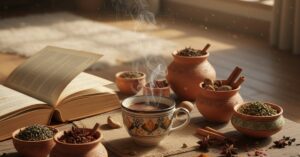
Yogic Chai: Insights into a Cultural and Philosophical Brew
In the quiet corner of a morning, before the world fully awakens, a ritual unfolds that is both simple and profound—a cup of chai. Yogic Chai, at its essence, is more than a beverage; it is an exploration into the depths of cultural history and philosophical thought. It calls to those who seek meaning in the nuances of tradition and philosophy, who understand that the art of chai is a mirror of life’s contemplative moments.
Philosophy & Stillness: The Self Beyond the Cup
Within the intricacies of Advaita Vedanta, the teaching ‘the Self is Brahman’ forms a cornerstone. It suggests that the true Self is identical with the ultimate reality. A casual translation misses the depth of its implications. Imagine sitting with a cup of chai, steam curling upward as your mind settles into stillness. Here, in this quiet moment, there is no separation between you and the experience. The act of drinking chai becomes a parallel to self-inquiry, where layers of perception fade away to reveal an unadulterated presence.
Nisargadatta Maharaj’s simple yet profound teachings, epitomized in ‘I Am’, redirect us from the clutter of identity towards the singular existence of being. While sipping chai, consider the warmth that spreads through your being—an undeniable reminder of existence itself, separate from roles and labels.
The Sovereign Self: A Philosophical Journey
In a world brimming with external authorities, the philosophy of individual sovereignty invites us to look inward. Drawing upon the teachings of Advaita, where the Self is irreducible, we explore the notion of living life answerable to one’s conscience first. This act of sipping chai in solitude becomes a metaphor for, and a practice of, inner authority. The gentle act of selecting leaves, brewing the perfect cup, and savoring it, reflects a commitment to one’s choices, shunning the clamor of outside influence.
Traditional Wellness & Ingredients: The Dance of Spices
A cup of chai is a symphony of spices, each a note in a harmonious blend with ancient roots. Traditionally used in Ayurveda, ginger warms and invigorates, while cardamom enlivens the senses. Cinnamon brings a balance that modern research suggests may support metabolic wellness. Sipping a carefully crafted chai is to partake in a tradition that acknowledges the body’s wisdom.
Consider black pepper, whose pungency enhances absorption and marries the flavors. Assam tea lends its robust earthiness, grounding the blend. The alchemy of these ingredients is both tradition and science, creating a brew that transcends each element’s singularity.
Nature & Ritual: The Art of Presence
As the first sip of chai passes your lips, the world around you slows, if only for a moment. There is something elemental about holding warmth against a backdrop of winter’s chill. It is an act of self-care spun through time, a moment to ground oneself amidst nature’s unpredictability.
Imagine the whisper of rain or the solitude of a mountain ridge. These contexts transform a cup of chai into an anchor, a sensory experience that demands nothing but presence. There is an art to stopping, to acknowledging a cup of chai as a microcosm of life’s unhurried pace.
Indian Chai Culture & History: A Story in Every Sip
Chai is woven into the fabric of Indian life. The chai wallah, poised at his stall, is a symbol of resilience and community. On bustling train platforms, chai stalls become a place where strangers soften into companions over a shared cup. Monsoon rainfalls provide a perfect backdrop for chai gatherings, where stories and weather dance in tandem.
In rustic kulhads—clay cups—the tea takes on an earthy aroma that complements its warmth. Chai’s role is not merely social; it etches itself into the daily grammar of existence, structuring time and easing transitions.
Culinary & Craft: Chai Beyond the Cup
To introduce chai into baking and cooking is to extend its philosophy into the culinary arts. The magic lies in understanding the marriage of spices—how cardamom and vanilla dialectically enhance a bake, or how a masala chai reduction can suffuse a dish with depth. Yogic Chai becomes a muse, a touchstone of creation rather than a simple ingredient.
The essence of chai in cooking is the art of balance, of complementing flavors without overpowering them. It challenges the cook to think deeply about each step, each ingredient, contemplating the history and philosophy within each choice.
Yogic Chai invites the thoughtful into its embrace, a symbol of life’s contemplative rhythm. In the crafting of a cup, there lies an invitation to pause, to reflect, and to connect with something greater than the sum of its parts. This is not just chai; it is a journey into consciousness, ritual, and heritage.