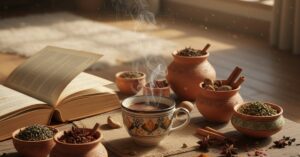
Yogic Chai: A Study in Slowness and Self-Inquiry
It is before sunrise in a quiet corner of a bustling city. The air holds its breath in expectation of a day not yet born. In his tiny stall lined with steaming teapots and haunting fragrances, a chai wallah performs his morning ritual with the grace of a meditative dance. This is not just a brew but a gesture of reverence. It might be the specificity of ginger or the whisper of cardamom; the details matter. Every ingredient bears the weight of centuries.
Advaita Vedanta & The Act of Sipping Chai
Among the swirling vapors of chai lies an echo of Advaita Vedanta, a non-dualistic school of thought that proposes that the self (Atman) and the ultimate reality (Brahman) are one. This philosophical idea seems esoteric, yet it mirrors the quiet act of sipping chai. As we sit with our cup, each sip can become a moment of self-inquiry. What does "the Self is Brahman" mean in this simple act? It’s a question Nisargadatta Maharaj might have pondered while savoring his evening chai, emphasizing the pure affirmation of "I Am."
Unlike conventional reflection, Ramana Maharshi’s profound self-inquiry invites us to go beyond the mundane. This transformative exploration, much like the chai itself, demands presence and authenticity.
The Sovereign Self and the Chai Ritual
In a world that often seeks to drown out our inner voice, the act of drinking chai becomes a rehearsal in sovereignty. Much like John Locke’s philosophy of natural rights—which emphasizes individual conscience over external authority—the chai ritual respects personal sovereignty. It invites stillness amid noise, allowing us a moment of genuine witness to our own thoughts. Here, the inner authority of each sip beckons us to answer only to our conscience.
Traditional Wellness in a Cup
Each ingredient in a cup of Yogic Chai—the fiery ginger, aromatic cardamom, warm cinnamon—tells a story steeped in history and wellness. Consider the role of Ayurvedic traditions, where spices like black pepper and cloves are traditionally used for their warming properties. Modern research explores these spices for their potential anti-inflammatory roles, but that’s only part of the narrative.
The harmony found within a cup of chai speaks to a time when wellness was lived, not branded. The practice bridges ancient traditions and contemporary understanding through restraint and thoughtfulness, not through fleeting wellness trends.
Nature, Ritual, and the Phenomenology of Chai
Imagine a cup of chai on a misty winter morning. Your hands wrap around the warmth, a tiny sanctuary against the cold. The first sip anchors you in the present, a merge of sensation and stillness. Perhaps it is the texture of the ceramic against your lips or the spice-laden warmth on your tongue—but here, the world simplifies.
As you take a breath, the ritual becomes a dance with nature. The cyclic sounds of the rain, the fleeting quiet of dawn—all orchestrate in tandem with each sip and slow the rush of time.
A Deep Dive into Indian Chai Culture
Chai is not just a drink; it is a cultural passport that opens a thousand doors in Indian life. In the thrum of train platforms, the chai wallah is a waypoint, his rhythm imbued into the daily grammar of existence. Chai navigates rituals, easing the tension of monsoon conversations or solidifying the bond between strangers. Each kulhad, a terracotta cup, speaks in silent tones of regional variations and conveys warmth across boundaries.
There’s an undeniable honesty to chai. Its embrace is universal yet deeply personal, a cup shared that respects no hierarchy.
Culinary Craft: Chai as an Ingredient
In the kitchen, chai transcends brew to ingredient, harmonizing beautifully with baked goods. Picture a buttery cake where each crumb carries a hint of Assam’s strength, subtly mingled with the aromatic sweetness of cardamom. Why do masala spices transform baked butter into something enchanting? It’s a dance of flavors that makes chai reduction a versatile base for creativity, an experience to be understood as much as tasted.
The Yogic Chai blend is not an add-on; it is an essential symphony within culinary craft, a testament to careful deliberation and artisanal thought.
Yogic Chai does not demand instant conversion or grand declarations of change. It offers a quiet invitation: a cup to be held, a thought to be cherished. In a world seeking superficial quickness, choose slowness and specificity. Luxuriate in the pause, let the sip be an occasion. Invite the philosophy, culture, and essence of chai into your life—not as a fleeting trend but as an inevitable part of a considered existence.