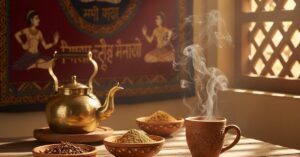
Yogic Chai: A Slow Brew with Philosophical Depth
As the first whispers of morning dew touch the earth, a quiet transformation unfolds in kitchens across India. A ritual as ancient as it is contemporary—brewing chai—awakens. This is not simply a drink but a philosophical experience, inviting slowness into our hurried lives. Let’s explore the layers of Yogic Chai, a beverage rooted in Indian contemplative traditions, resonant with the philosophy of Advaita Vedanta.
The Stillness Within a Cup: Advaita Vedanta and Chai
Advaita Vedanta, central to Indian philosophy, focuses deeply on the unity of the self with the divine or Brahman. The phrase “The Self is Brahman” echoes not as an abstraction but a practice—inviting us to recognize the profound oneness underlying existence. When we sit with a cup of Yogic Chai, we partake in this quiet recognition. The act of brewing becomes a meditation, an experience of stillness where every ingredient has its place and purpose.
Consider the words of Nisargadatta Maharaj, who emphasized the core presence of ‘I Am’—a space to discover identity beyond societal labels. In the simmering meld of spices, milk, and tea, a similar self-inquiry unfolds. The senses engage, then retreat, creating a moment suspended from time, inviting you to explore the essence rather than the surface of being.
The Sovereign Self: Autonomy in the Ritual
The sovereignty evident in each of us mirrors the simple autonomy inherent in making chai. John Locke’s philosophy—where individual conscience stands independent—echoes through the ethos of Yogic Chai. Through the slow, singular focus of crafting a blend, we honor our inner witness, free from external dictates.
Brewing chai allows us to reconnect with this autonomy. It’s in the deliberate measurement of spices, the precise timing of its boil, the choice of tea leaves. Each decision reflects an alignment with one’s own sense of taste and tradition, unmediated by societal pressures. Here, the act of preparing chai becomes an assertion of individuality, a tribute to personal sovereignty.
Traditional Wellness: Spices and Health
The global trend towards natural ingredients in wellness is foundational in Indian culinary practices, especially chai. Each spice—ginger, cardamom, cinnamon, cloves, and black pepper—carries centuries of wisdom. In Ayurveda, these ingredients are not merely flavors but tools of balance and healing.
Ginger, traditionally used for digestion, embodies warmth and depth. Cloves add an analgesic edge, studied for their role in soothing discomfort. Each sip of Yogic Chai offers more than taste; it delivers an introduction to wellness through thoughtful consumption.
Nature and Ritual: Chai in the Elements
Picture a misty morning where the gentle hum of rain lulls the world. You clasp a chai cup, its warmth effusing through your fingers. In this contained moment, nature and ritual entwine. This sensory symphony brings focus, not escapism.
Why does warmth instinctively calm us? Holding that cup amidst a winter chill, perhaps we find an echo of the hearths from our ancestry, a quiet continuity. Yogic Chai thus becomes a tactile meditation, a pause in nature’s rhythm where each sip anchors us to the present.
Chronicling Indian Chai Culture
In a nation where history breathes through everyday acts, chai stands as a cultural emblem. More than a drink, it extends its roots deep into the societal and economic fibers of India—where train station stalls bustle with chai wallahs, where monsoon conversations are punctuated by its warmth.
The indigenous kulhad, a clay cup, adds an earthy ethos, blending sustainability with tradition. Beyond its utility, the kulhad quietly narrates artisan stories, embedding chai in the daily anthology of Indian life.
Culinary Craft: Chai as an Ingredient
Beyond the cup, chai spills into culinary creativity—becoming an art form. Consider the transformative role of cardamom in pastries. Its interplay with vanilla creates a symphony of aroma and taste. A chai reduction weaves into butter cake, infusing subtle notes of spice, which lingers as an afterthought.
Yogic Chai invites you to explore this alchemy, to view spices not as constants but dynamic participants. It’s this philosophy of thoughtful ingenuity that turns each culinary attempt into a considered craft.
In the unhurried world of Yogic Chai, the traditions of philosophy, wellness, and craft unravel delicately. Each cup serves as an unfathomable well where the essence of life, freedom, and culture converge, challenging us to be more mindful. Try brewing your cup with intention, and allow the process itself to enlighten.