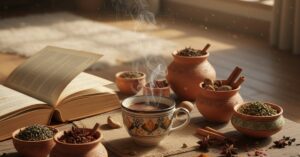
Embracing Slowness with Yogic Chai: A Ritual of Precision
It begins with the faint aroma of spices drifting through the air, a delicate symphony of scents that whisper promises of warmth and quietude. The act of preparing chai is neither rushed nor thoughtless; it is deliberate, layered with a rich history, and indicative of a philosophy that values the slow unfolding of meaning.
The Interplay of Philosophy and Stillness
In an era where speed often supersedes satisfaction, the philosophies of Advaita Vedanta and the contemplative teachings of the Upanishads offer a refuge—a reminder, perhaps, that in the stillness of a quiet mind, real understanding can be nurtured. Here lies a deep-seated philosophical proposition: the Self, the individual essence, is not a fragmented being but a complete and integral part of the universal reality, Brahman.
Perhaps analogous to the brewing of chai—where each element finds its harmonious place in the ensemble—we see the promise of a profound unity in the teachings of sages like Nisargadatta Maharaj and Ramana Maharshi. Their words, ‘I Am’ and the practice of self-inquiry, respectively, do not ask for vague acknowledgment but challenge us to perceive the simplicity and unity within complexity.
As you sit down with a cup of Yogic Chai, consider it not merely a pause but a time of alignment, where the act becomes a microcosm of a larger existential truth—a meaningful joining of parts that feels inevitable but is rewarding in its patience.
The Sovereign Self: Autonomy in a Cup
In drinking chai, we engage in an act of personal sovereignty. It is the quiet rebellion against external pressures, a reclaiming of one’s time and sensation. Advaita Vedanta’s recognition of the Self as irreducibly whole critiques the intrusion of any external authority that questions our inner witness. This autonomy finds its ally in classical liberal thought—thinkers like Locke and Overton—who argue for the inherent dignity of individual conscience.
To live as a fully realized human being, answerable primarily to our conscience, requires a wisdom that sees beyond coercion to individual volition. In this act of chai-making, there lies an affirmation of personal choice over hurried consumption. It’s about engaging with life as thoughtfully cultivated as a carefully crafted blend of spices and tea.
The Art and Science of Ingredients: A Closer Look at Ginger
Among the roster of spices that constitute chai, ginger stands as a sentinel of warmth and balance, revered in Ayurvedic tradition for its myriad benefits. Known traditionally for its potential to ‘ignite Agni’ or digestive fire, it threads through the bowls of curative broths as well as the billowing steam of a chai pot.
Modern research complements this ancient understanding, investigating ginger’s anti-inflammatory properties and its ability to support digestive health. Yet, to view ginger merely through a lens of utility diminishes its cultural significance. As it graces the chai, it brings tales of its roots in India, anchored to both medical tomes and grandmothers’ kitchens—a spice that carries history with each slice and bruise.
Nature and the Phenomenology of Pausing
Imagine a chill morning where the sun rises hesitantly, illuminating a landscape swathed in dew. Clasping a cup of steaming chai, you feel the warmth seep into your skin—a tiny hearth against the chill. This is where chai becomes an experience in slowness, a tactile symphony that grounds the ever-fluctuating senses.
To pause is not to escape, but to encounter the universe through a narrowed stillness. With every sip, the chai unfurls a narrative seasoned by each grain of sugar, whisper of cinnamon, and shadow of Assam. The ritual captures a momentary peace amidst the bustle. For those who practice slowness, such instances are treasures of existence, repeated but never redundant.
Indian Chai Culture: A Social Chronicle
Beyond its nuanced flavors, chai is woven intricately into the tapestry of Indian life. It’s not uncommon to find a chai wallah, the purveyor of this comforting balm, setting up shop amid the vivid chaos of markets or the serene quiet of train platforms. Here, chai is democratic—the elixir bridging conversations across disparate socioeconomic divides.
The monsoon season deepens chai’s appeal; rain becomes a backdrop against which stories are shared, warmed by the caress of a chai strain into a clay kulhad. This tradition, regional yet universally recognized, speaks of chai’s ability to punctuate the progression of time—morning to afternoon, stranger to acquaintance, promise to fulfillment.
Culinary Craft: The Alchemy of Chai in Baking
The culinary application of chai transcends its liquid form, infusing desserts with its spicy allure. Consider a simple butter cake. Introduce the fragrant notes of a YogicChai balance as a reduction, and the ordinary becomes extraordinary. Cardamom finds a companion in vanilla; they dance effortlessly, heightening the aromatic experience.
This isn’t about lists or hacks; it’s alchemy—one grounded in an appreciation for flavor dialectics. Crafting with chai extends a subtle invitation to appreciate culinary depth, much like mastering a musical instrument—notes, like spices, disclose their complexity upon engagement.
In recognizing the artful intersection of culinary craft and chai, we return time and again to the central thread of harmony—a small reflection of the myriad ways slow living unveils richness in the specific and deliberate.
Our lives often mirror the depth of a well-brewed cup, measured not in grand strokes but in the subtleties and an unhurried reckoning with meaning that each moment offers. In each cup of Yogic Chai, there lies a testament to slowness, to precision, to life lived justly and joyously.