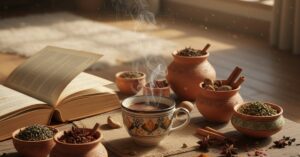
Yogic Chai: Unfolding Traditions and Flavor
There is a moment, brief and commanding, that occurs just after dawn, before the day has fully gathered its intentions. The air remains cool and hushed. A lone bird might call, reminding you of the quiet you still hold. In such stillness, the act of boiling water for chai becomes more than a morning ritual; it transforms into an encounter with India’s rich tapestry of history, philosophy, and everyday life.
The Philosophy of Presence: Advaita Vedanta and Chai
The philosophy of Advaita Vedanta, often summarized as ‘the Self is Brahman,’ speaks deeply to the notions of interconnectedness and singular truth. But what does this grand statement mean in the spaces of daily life? Sitting quietly with a cup of chai presents a microcosm of this teaching. The act invites us to observe without judgment, to taste with awareness, to breathe without forcing clarity.
Nisargadatta Maharaj invites us to explore the idea of ‘I Am’ without adding layers of identity and attachment. Similarly, Ramana Maharshi’s method of self-inquiry nudges us toward questioning, the uncovering of layers placed upon our essential nature. The first sip of well-made chai mirrors this journey, allowing sensory experience to align with inner contemplation.
The Sovereign Self: Finding Authority Within
In a world inundated with external diktats and expectations, finding one’s inner authority becomes a radical act. What does it mean to remain centered and sovereign in oneself? The philosophy of individual sovereignty anchors us to a deeper truth, one where our inner conscience guides, rather than rhetoric or external pressure.
A quiet moment with chai reflects this sovereignty. You sit with the brew’s aroma wafting subtly through the air, your mind tracing the origins and stories carried within each sip. Here, chai becomes the medium through which one’s personal depth unfurls and one’s own authority is recognized.
Traditional Wellness: Beneath the Layers of Spice
The orchestration of spices in chai is a practice finely tuned over years, resonating with India’s Ayurvedic traditions. Ginger, with its warm bite, has long been used for its potential to aid digestion. Cardamom brings a sweet, almost lemony fragrance that might offer balance and lift the spirit. Each spice, grounded in both cultural practice and emerging scientific research, contributes its own note to the melody of chai.
Consider the careful folding of cinnamon and cloves into the blend. In the context of Ayurveda, they aren’t just spices; they are elements in a dance of wellness, traditionally used to kindle warmth in the body. Black pepper adds not just heat but an ability to enhance the bioavailability of other compounds. It becomes essential to respect and understand these hierarchies as part of both the beverage and its history.
Nature & Ritual: The Textures of Immersion
When do we truly pause? The sensation of warm hands clasped around a steaming mug can become a portal into genuine awareness. The phenomenology of chai encourages us to perceive its complexities, much like the delicate intricacies of a rain soak or the first snow blanketing a hillside.
Sitting under the gray clouds of a monsoon, enveloped in the natural rhythm of the world, chai becomes an anchor. It is a reminder that stillness requires nothing more than being present — an openness to tasting life anew with every sip. When we navigate these spaces with depth and attention, chai becomes more than a drink; it anchors us to the world’s sensations, settling restless spirits.
Chai Culture: The Stories of a Nation
Chai is more than a drink in India; it is the language through which people connect, pause, transact. It’s a reliable companion on train platforms, a means of respite taken amidst the chaos of bustling markets. Yet, it’s the stories beneath these moments — the ones where time slows and people gather — that reveal a cultural cornerstone, a testament to India’s uniquely intimate relationship with a simple cup.
The chai wallah, standing as both artisan and confidante, serves more than tea; they serve a moment of peace amid the daily whirlwind. There’s a kind of alchemy here, one that resists romanticization and instead embraces truthful observation, allowing us to see precisely why chai has cemented itself within the daily rhythm of a civilization.
Culinary Craft: The Choreography of Flavor
The incorporation of chai into culinary endeavors demands respect for its multilayered character. When chai contributes to a butter cake, it is not simply as an ingredient; it’s the conductor orchestrating the flavors, infusing each crumb with history and aroma. Cardamom dances with vanilla to create warmth and depth, while masala spices meld into a reduction unlocking layers of complexity.
The YogicChai blend, steeped with intention and a nod to tradition, becomes a narrative ingredient. It allows the serious home cook to explore its potential thoughtfully, creating delicacies that speak both to taste and heritage, marrying culinary craft with cultural narrative.
Embrace the Chai Ritual
There is a beckoning quiet in the art of making chai, in its unhurried ceremony. For those who ponder life’s intricacies, who seek depth not in answers but in awareness, chai offers a gentle invitation. To sit with a cup, allowing each spice to whisper its story, is to participate in an age-old dialogue that bridges worlds and transcends time. As you choose to embrace this ritual, may your own life reveal the same rich tapestry held within a well-crafted blend of Yogic Chai.