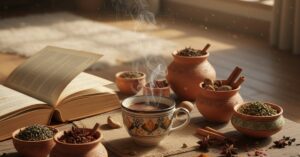
Yogic Chai: A Contemplative Journey into Indian Tea Culture
The monsoon had arrived with its customary fanfare, orchestrating a symphony of raindrops that danced tirelessly against weather-worn rooftops. The city streets of Mumbai sparkled, freshly baptized by the rains, while steam rose alluringly from the tea stalls lining the avenues. Here, the stirring of chai is more than a sound; it’s a rhythm that tempers the day’s hustle and offers solace to the steady march of daily life.
Philosophy & Stillness
The Contemplative Nature of Chai
Within the folds of Indian life, chai holds a sacred position not due to ancient mysticism but rather because of its role in everyday meditations. This ordinary beverage transforms into an extraordinary tool for understanding self and stillness. Advaita Vedanta, a cornerstone of Indian philosophy, posits that consciousness is the ultimate reality. In this lie the resonances of Nisargadatta Maharaj’s teachings — a reminder that ‘I Am-ness’ encompasses the journey of human cognition.
The quiet act of sitting with a cup of chai parallels this pursuit. It demands presence without pretense. Channeling the wisdom of Ramana Maharshi’s self-inquiry, the focus here is not on achieving enlightenment but on cherishing the purity of the experience, savoring each sip without distraction. This chai, then, is more than refreshment; it becomes an acknowledgment of the timeless self within.
The Sovereign Self
An Inner Journey
As we contemplate sovereignty, the inner landscape becomes the territory we must explore and cultivate. Envision the process of brewing chai as a metaphor: each decision — the blend of spices, the heat of the water, the duration of the steep — a reflection of human agency. Advaita philosophy underscores that true authority lies within, beyond societal impositions.
In this cup, individuality and freedom intertwine seamlessly, inviting us to honor our inner witness with the same reverence we hold for the perfect blend of chai spices. The sovereign self, much like the experience of chai, defies external categorizations, evoking a steadfast allegiance to one’s own conscious evolution.
Traditional Wellness & Ingredients
The Spices of Chai
Ginger, cardamom, cinnamon, cloves, and black pepper — the essence of chai is a hymn to traditional wellness. Each spice, honored in Ayurvedic medicine, plays a role far greater than its culinary appeal. Ginger, for instance, is celebrated for its warming properties, potentially supporting digestion. Cardamom and cinnamon, aromatic at their heart, may contribute to metabolic harmony as well as elevate the complexity of flavor.
While we embrace these scientific insights, it’s equally essential to appreciate their cultural dimensions, as each spice narrates its own story, rooted in both ritual and tradition. Yogic Chai, a blend that pays homage to this heritage, invites you into a deeper understanding of how nature’s offerings sustain us beyond mere nourishment.
Nature & Ritual
A Moment of Both Earth and Sky
The chai ritual exemplifies the beauty of simplicity, urging us to pause amid the whirlwind of existence. Picture a winter morning, where the air bites with cold precision, yet your hands find warmth cradling a steaming cup. There is an elemental joy in the phenom of touch and warmth, a grounding quality that offers a moment over mere sustenance.
Such is the ritual of chai — where boiling water meets tea leaves, earth meeting sky — creating a space for introspection. In these moments of shared ritual, chai becomes an anchor, tethering us to the present with grace and serenity.
Indian Chai Culture & History
The Weave of Everyday Life
Chai in India is much more than a beverage. It’s a social architect, shaping moments of togetherness, marking time, softening the edges of formality, and welcoming quietude among strangers. The tea stalls of India’s bustling platforms offer chai as an antidote to daily rush, a brief respite to travelers.
To understand chai’s role in Indian culture is to peel back layers of its entrenched societal significance. From the artistry in a kulhad’s earthen embrace to the chai wallahs who persist as stewards of this liquid tradition, India’s chai culture reveals its heart — one that beats in harmony with everyday life’s rhythm, amid its complexities and simplicity.
Culinary & Craft
Crafting with Chai
The inclusion of chai in the culinary arts is a testament to its versatility. The union of cardamom with vanilla in a butter cake reveals layers of flavor, nuanced and profound. Meanwhile, a steeped chai reduction transforms into an inspired flavor base for creative endeavors in the kitchen.
This is not about recipes but intentions — the way in which a sprinkle of masala spices elevates a dish beyond its components. Chai becomes a muse, enchanting in its own right, inviting contemplative creativity within the process of cooking.
So, as you embrace the textured tapestry of Yogic Chai — with its philosophy, freedom, wellness, ritual, culture, and culinary craftsmanship — may it serve as an inevitable part of your thoughtful existence, a companion to the contemplative moments that shape our living.