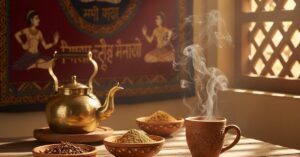
Yogic Chai: A Contemplative Exploration of Self and Flavor
There is a world in your teacup, a microcosm of the larger narrative of life. As the steam rises, it carries not merely an aroma of spices but whispers of ancient dialogues and the warmth of self-discovery. This, is the essence of Yogic Chai—a ritual imbued with the philosophies of Advaita Vedanta, and a faithful companion in your journey of understanding and clarity.
The Philosophy of Still Tea
In the words of Nisargadatta Maharaj, “I Am” is a profound statement, echoing through the corridors of time, calling for an exploration of self beyond mundane experiences. When you sit with a cup of Yogic Chai, you engage in something akin to self-inquiry, not merely losing yourself in flavor but in thought. What does it mean to truly be? The warm chai, a tangible presence, anchors you in the practice of being, offering a serene moment where the external world fades into the background.
This isn’t about metaphor but about coexistence. The quiet act of drinking chai aligns with Ramana Maharshi’s self-inquiry, urging you to cast aside ordinary reflection in favor of a deeper connection with your true nature. The chai’s warmth comforts, yet its philosophy challenges.
The Sovereignty Within
To engage with chai is to engage with yourself. It becomes an embodiment of your own authority and freedom—a pause where no external clamor can intrude. In a world dictated by ever-increasing speeds and demands, the chai ritual becomes an act of sovereignty.
Borrowing from the archives of classical liberal thought and Advaita, we discern a narrative that prioritizes the self’s irreducibility. This isn’t a political delineation but a philosophical one. The essence of Yogic Chai invites you to examine the dignity of your existence, where conscience outweighs all external mandates.
An Exploration of Ingredients
Each sip of Yogic Chai offers more than pleasure; it offers history and knowledge. Consider the humble ginger—a spice studied for its anti-inflammatory properties yet deeply embedded in Ayurvedic tradition as ‘Zingiber officinale.’ How ginger interacts with the robust Assam tea, the sweet touch of cardamom, or the sharpness of black pepper, isn’t a random culinary decision. It is narrative craftsmanship of Ayurveda and a testament to generations of Indian culinary craft.
And let us not forget cinnamon and cloves, powerful spices traditionally celebrated for their warming qualities. The choice isn’t about mirage-like wellness promises; it’s about an education emanating from cultural and historical wisdom.
Nature’s Ritual in Your Hands
A cold morning bears a different flavor when experienced with a chai cup in hand. The icy air sharpens your senses, creating a poignant contrast with the warmth you cradle. The silence amplifies the taste, and each sip brings a new layer of discovery. Here, in this space, you learn the real meaning of pause.
The chai’s heat seeps into your fingers, into your very being, as you reconcile the unpredictable nature of existence. This is why Yogic Chai excels—not because it claims to slow time but because it situates you firmly at the center of the moment.
Chai’s Cultural Canvas
India harbors an intricate chai tapestry, not captured by romantic hues but by lived reality. From the bustling platforms of train stations, where the chai wallah serves warmth and humanity, to monsoon celebrations where chai becomes a shelter from incessant rain, this cultural mainstay goes beyond a mere beverage. It is a language of its own, a daily grammar in Indian life.
Considering regional variations, northern kulhads offer an earthy flavor, effortlessly merging with the clay they pour into. Each region tells its own story, united by chai yet unique in approach and taste. Yogic Chai honors this narrative, not by mimicking it, but by offering a consistent homage to its complexity and variegated history.
The Art of the Perfect Blend
Cooking with chai reveals another dimension of its craft. Masala spices transform butter cake, not merely complementing, but illuminating flavors otherwise dormant. Cardamom pairs with vanilla, not just in taste but in fragrance, influencing the air around you. When using a steeped chai reduction, it emerges as a symphony of flavors—a creative ingredient, elevating culinary practice.
Yogic Chai doesn’t ask to be the center of your culinary repertoire but offers its richness for discovery, exploration, and revelation. It isn’t about discovering a game-changer; rather, it’s about an invitation to deliberate culinary craftsmanship.
Conclusion: Chai as a Lifelong Companion
In the end, Yogic Chai becomes more than a simple brew. It transcends its form to engage with the profound, the cultural, and the personal. It’s a drink but also a conversation with the self, a bridging of cultures, a craft celebrated daily. To enjoy Yogic Chai is not to consume but to engage in a ritual that continuously earns its place in the thoughtful life, not by pomp but by quiet depth.